- Circular Rising
- Posts
- Bioconversion gains traction in Africa’s waste economy
Bioconversion gains traction in Africa’s waste economy
Source: Continent Rising
From the newsletter
Across the continent, a new approach to tackling waste is emerging as companies convert organic waste into valuable biological products. The latest example is in Accra, where a partnership between local and Danish companies will build a $2.9 million insect-based facility to process organic waste into animal feed protein and organic fertiliser.
Bioconversion is the process of using living organisms or biological systems to convert organic materials into useful products such as animal feed, fertiliser, bioenergy and industrial ingredients.
Organic waste accounts for at least 57% of Africa’s municipal solid waste, providing a substantial feedstock base for bioconversion pathways.
More details
The Ghana project is a partnership between local waste management company JSO Waste and Danish firms Insectum ApS and Michael Bundgaard Holding ApS. Once completed, the facility in Accra will be the first commercial plant developed by Insectum and its first project in Africa. It is expected to process 8,000 tonnes of organic waste annually into protein ingredients for animal feed and organic fertiliser. This will help address mounting organic waste in Accra while supporting the country’s agricultural sector.
There are several forms of bioconversion, but insect bioconversion, anaerobic digestion and composting and biofertiliser production are among the most common across Africa. In insect bioconversion, insects, most commonly black soldier fly larvae, are used to convert food waste, agricultural residues and manure into high protein animal feed, organic fertiliser and soil amendments. The planned facility in Accra will use this method. Elsewhere on the continent, companies such as Regen Organics and BioBuu in East Africa are using black soldier fly larvae to convert food and agricultural waste into insect protein for livestock and aquaculture feed, as well as organic fertiliser. In Southern Africa, Inseco is developing large scale insect protein production using similar technology.
For anaerobic digestion, microorganisms break down organic waste in the absence of oxygen to produce biogas for energy and nutrient rich digestate used as fertiliser. The technology is increasingly being deployed to process food waste, manure and agricultural residues, offering a way to manage organic waste while generating renewable energy. In Kenya, the Biojoule Biogas Plant processes market and food waste to produce biogas for energy use. Meanwhile in Durban, the Bronkhorstspruit Biogas Plant converts agricultural waste into renewable energy and fertiliser products.
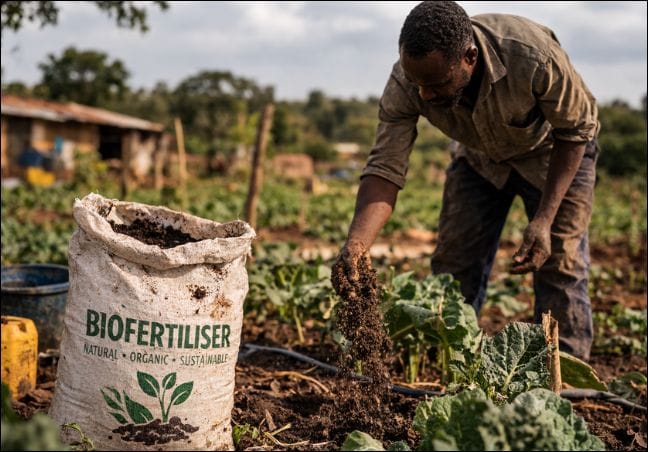
Composting and biofertiliser production involve the processing of municipal and agricultural organic waste into fertiliser and soil products. This includes composting technologies, microbial waste treatment and the production of biofertilisers. The opportunity is significant as organic waste comprises a significant percentage of municipal waste in many African cities. Several initiatives are tapping into this opportunity. In Cape Town, Reliance Compost processes municipal green waste into compost for agriculture and landscaping. In Nairobi, Regen Organics converts organic waste into fertiliser through thermophilic co composting, a microbial process that breaks down feedstocks into nutrient rich soil products. Meanwhile in Accra, Jekora Ventures has developed composting operations to process municipal organic waste into fertiliser products.
Africa offers fertile ground for bioconversion due to the large volumes of food and organic waste that remain largely unprocessed. At the same time, there is strong agricultural demand for the products generated through these systems. The continent’s livestock and aquaculture industries require affordable protein feed and soil nutrients, creating ready markets for bioconversion outputs. Infrastructure gaps also strengthen the case. Because traditional recycling systems remain limited in many parts of Africa, biological waste treatment solutions can bypass complex material recovery infrastructure and offer a more adaptable pathway for processing organic waste.
Bioconversion also presents a growing employment opportunity across Africa’s waste and agricultural sectors. From waste collection and sorting to insect farming, processing and fertiliser production, these systems create jobs across the value chain. As bioconversion facilities scale, they could support new forms of green employment while strengthening local waste management and agricultural supply chains.
However, promising as these innovations are, they face several challenges. Waste collection and segregation remain inconsistent, regulatory frameworks for insect protein are still evolving and access to financing for scale up remains difficult for early stage startups. In addition, supply chain logistics for organic waste streams can be unpredictable, complicating efforts to secure reliable feedstock.
Our take
Besides helping reduce pressure on landfills, bioconversion offers farmers a way to cut reliance on imported inputs that leave agricultural systems vulnerable to global supply chain shocks and price fluctuations.
It can also support healthier farming systems by producing natural feed and fertiliser alternatives with minimal chemical additives.